Guide • 6 min read
How to Transcribe Freestyle Rap
You went off in a freestyle session, nailed every bar, and now you can't remember half of what you said. Here's how to capture those lyrics before they're gone forever.
The Freestyler's Dilemma
Every rapper knows this pain. You're in the zone, bars are flowing, you record it on your phone — and then an hour later, you can't remember that killer punchline from the second verse. Listening back doesn't always help. The beat's loud, you were spitting fast, and trying to transcribe it manually means playing 2 seconds, pausing, rewinding, playing again... for 3+ minutes of audio.
The r/makinghiphop community recommends a simple but labor-intensive workflow: "Record and review using your phone, freestyle for one minute, transcribe the best lines, drop the bad stuff, and add the good lines to your vault." The problem? That transcription step can take 20+ minutes for a single freestyle session. One transcriber noted that "Earl Sweatshirt's work alone took me 20 hours" — highlighting just how time-consuming this process can be.
Why Generic Transcription Tools Underperform on Rap
If you've tried using speech-to-text apps on your freestyles, you've probably gotten gibberish back. That's not a bug — it's a fundamental limitation of how these tools are built.
- Speech-to-text apps like Apple's Voice Memos transcription are trained on talking, not rapping. They interpret sung or rapped words as noise, especially with fast flows.
- Cultural context blindness is another issue. Generic AI doesn't understand slang, regional references, or wordplay. When LL Cool J addresses "Farmers!" he's talking about Farmers Boulevard, not agriculture.
- Background music interference confuses everything. Standard speech recognition can't differentiate between your lyrics and the instrumental, leading to complete nonsense output.
- Ad-libs and vocal layers create overlapping audio. DaBaby's "Let's go!", Lil Jon's "YEAH!", background vocals — these overlap with main lyrics and confuse automated systems.
Rap can be transcribed reliably with music-focused models, but speed, slang, ad-libs, and loud instrumentals still affect raw output quality. The practical approach is: get a strong first pass automatically, then do a quick cleanup in the editor.
What Affects Freestyle Transcription Quality
Rap and hip-hop are fully supported. These factors mainly determine how much post-editing you’ll need.
- Double-time and complex flows involve doubling the speed of lyric delivery. The enunciation trade-off is real: "If you enunciate too much it doesn't allow you to get in enough words quickly. But if you don't enunciate enough then you sound like you're mumbling." This creates a transcription nightmare.
- Mumble rap and stylistic choices emphasize sound and rhythm over clear diction, so a short cleanup pass is often needed after auto-transcription.
- Slang and invented words cause problems because "there are particular words and expressions in rapping that won't show up in typical conversation," which means they're not in the AI's training data. The Anthology of Rap famously misheard Black Thought's "Cazal goggles" (a brand of eyewear popular in the 1980s) as "Gazelle, goggles."
- Intricate rhythmic patterns are "too intricate to reduce with simplified notation." Traditional Western music notation fails to account for non-semitonal pitch movements and the percussive nature of rap delivery.
A Better Approach: Music-Trained AI
The key difference is training data. Standard speech recognition is trained on meetings, podcasts, and phone calls. Music-trained AI is trained on actual songs — with vocals, instrumentals, and all the complexity that comes with it.
Modern approaches use source separation (tools like Demucs) to isolate vocals from instrumentals before transcription. Combined with AI models specifically adapted for singing and rapping, accuracy improves dramatically. When vocals are isolated from background music, lyrics can be transcribed "much more accurately."
Here's how to transcribe your freestyle with LyricTime:
- Upload your recording. Drag and drop your voice memo, audio file, or whatever you recorded on. MP3, M4A, WAV — any format works. The AI separates vocals from any background beat automatically.
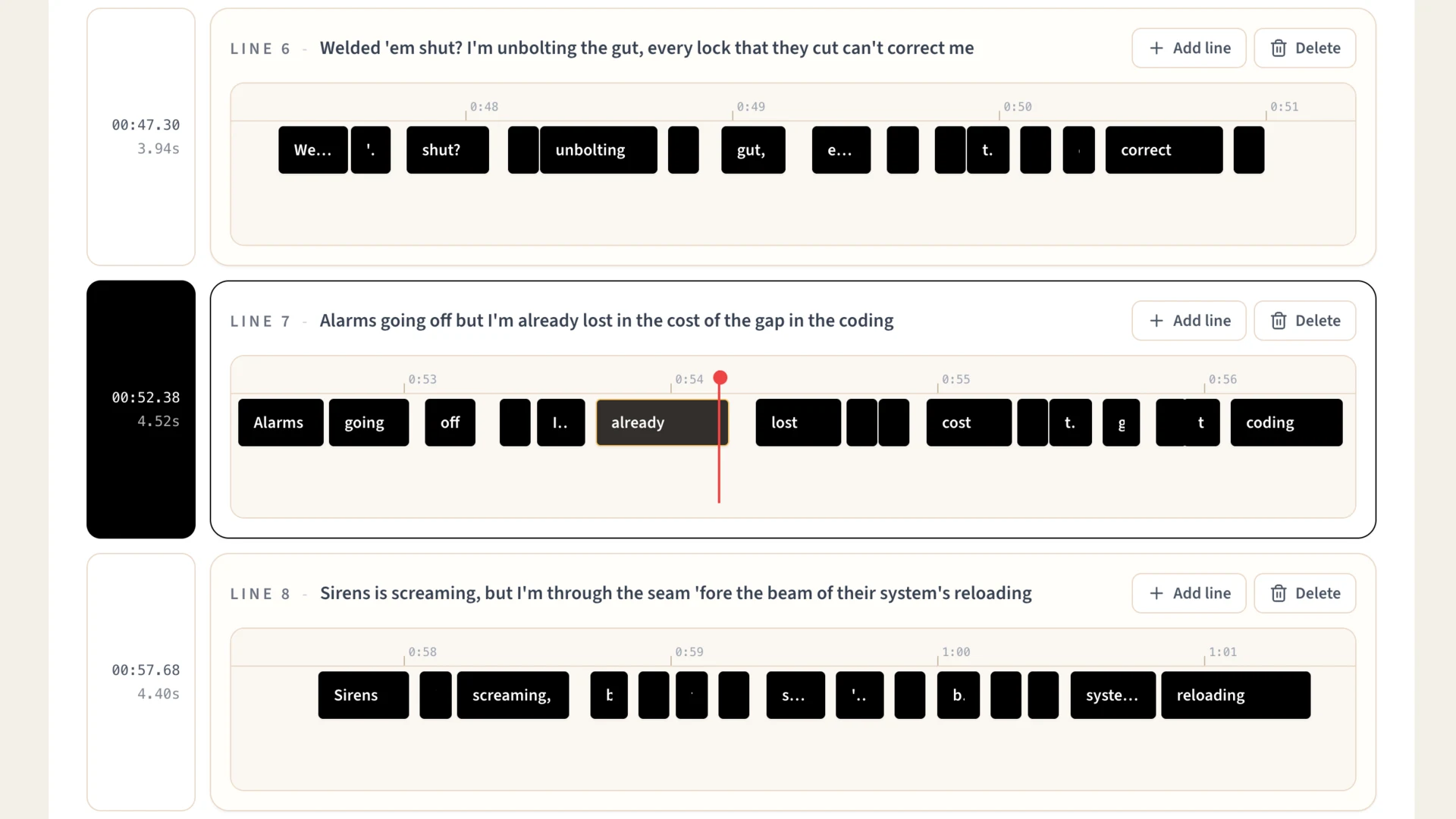
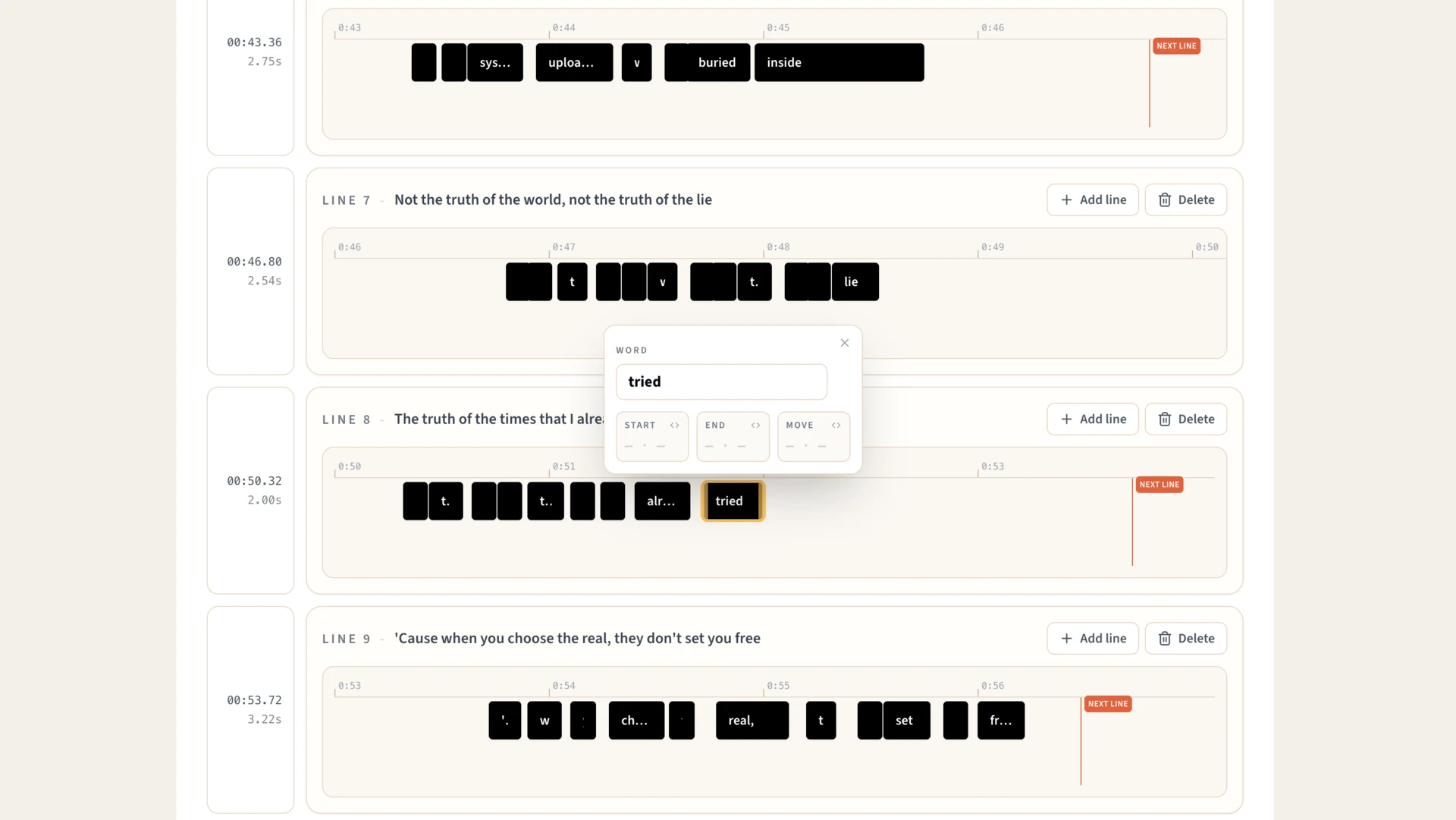
- AI transcribes with timestamps. In 30-60 seconds, you get your bars written out — line by line, with timestamps so you can jump to any part. The music-trained AI handles fast flows, slang, and ad-libs better than speech tools.
- Edit and build your vault. Fix any lines the AI missed, then export. Copy to your notes app, add to your bar vault, or save as a text file for later reference.
Pro Tips from Experienced Rappers
Beyond just transcribing, here's how experienced freestylers optimize their workflow.
Harry Mack, considered one of the world's best freestylers, uses a highly organized approach: "One of the most admirable aspects of Harry's approach is how compartmentalized his practice of rap is. Looking through his catalogue, you can see him picking one thing at a time to 'fix.' One month he works on removing verbal ticks, the next month he memorizes more 'suggestion words,' then adlibs, then melody."
Transcribing your freestyles is essential to this process — you can't fix what you can't see. Reading your transcribed bars reveals patterns, filler words, and repeated bits that you'd miss just listening.
- Build rhyme banks from your transcriptions. From r/makinghiphop: "Make huge lists of rhymes for words that I like... then try to create phrases that puzzle them together in a cool way." Your transcribed freestyles become raw material for polished verses.
- Use the "freestyle and refine" method. "Freestyle over beats and then transcribe your words to refine them. Sometimes I freestyle and transcribe it and edit that." This combines the spontaneity of freestyling with the polish of written rap.
- Review while it's fresh. Transcribe and review your freestyle the same day. You'll catch AI mistakes faster when the bars are still in your head.
- Keep the beat at reasonable volume. If you're freestyling over a beat, don't have it so loud it drowns out your vocals. The AI handles instrumentals, but clearer vocals = better results.
When You Need This
- Cypher and battle prep. "If you want to shine in a cypher you should prepare written lines." Transcribe practice sessions to identify your strongest material before battles.
- Building your bar vault. Tag your best transcribed lines with emotions ("funny," "violent," "introspective") so you can find them when the perfect time comes.
- Studio session prep. After recording freestyle takes, transcribe them to edit and refine verses before final production.
- Analyzing your flow. Listening back is "the fastest way to hear where your rhythm is strong and where it falters." Transcriptions let you see it too — did you rush? Bury a punchline under extra syllables?
FAQ
Does it work with fast flows and double-time?
Yes. Music-trained AI handles rapid-fire delivery better than speech tools because it's trained on actual music. Very complex flows might need some cleanup, but you'll get a solid foundation to work from — much faster than transcribing manually.
What about slang and made-up words?
The AI does its best with slang and may spell invented words phonetically. That's what the editor is for — quick fixes take seconds. The goal is to get 80-90% right automatically so you're not starting from scratch.
A cappella vs. over a beat — which works better?
A cappella actually works great because there's no beat competing with your vocals. But freestyles over beats work too — the AI separates the vocal from the instrumental before transcribing. Just keep the beat at reasonable volume relative to your voice.
Is my freestyle kept private?
Yes. Your audio is processed and immediately deleted — we don't store your files. Your unreleased bars stay unreleased.
